
 نویسنده :
The End of Static Badges: How TrustEmblem Redefines Digital Credibility with Real-Time TaaS
The Vulnerability of Static Trust in a Modern Ecosystem
For two decades, online businesses relied on static trust badges embedded in headers and footers to signal SSL encryption, payment compliance, or identity verification. However, these static images possess a fatal flaw: they are completely disconnected from the underlying systems they claim to validate. A fraudster can copy a high-resolution security badge image in seconds, placing it on a scam landing page without undergoing a single security audit.
This vulnerability extends deeply into creator economies and Web3 frameworks. Impersonators clone popular Telegram channels, YouTube accounts, and Instagram stores, intercepting payments and defrauding communities. In the blockchain sector, fake NFT smart contracts and spoofed decentralized app (dApp) domains result in millions of dollars in lost funds annually.
To restore genuine consumer confidence, organizations are moving beyond static markers toward dynamic, live-audited infrastructure. The industry shift requires shifting from passive trust claims to active, continuously verified proof.
“Never trust a static badge—trust the live registry.” Digital authority requires continuous, programmatic proof rather than decorative, static certificates.
Introducing TrustEmblem: Continuous Trust-as-a-Service (TaaS)
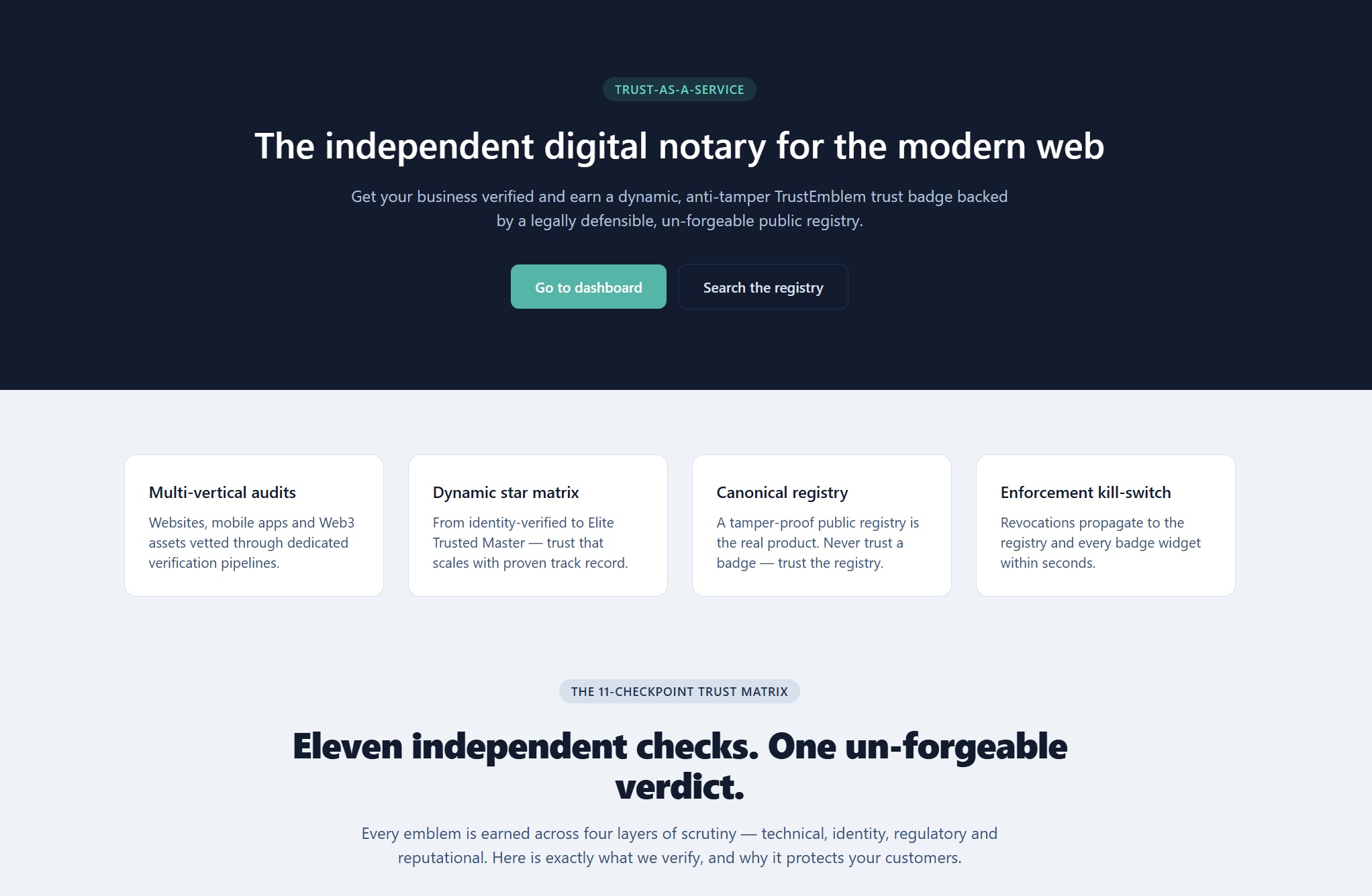
TrustEmblem addresses the modern credibility gap by replacing static assets with an active, automated verification layer. Operating under the concept of Continuous Trust as a Service (TaaS), TrustEmblem operates an autonomous background engine that monitors digital assets 24 hours a day, 7 days a week.
Rather than issuing a decorative graphic, TrustEmblem connects directly to a business’s public infrastructure, smart contracts, SSL configurations, and domain records. If a security certificate expires, a domain link breaks, or an authorized social handle changes unexpectedly, the system detects the anomaly instantly.
The Active Trust Lifecycle
The core mechanism powering the TrustEmblem platform relies on three continuous operational phases:
- Automated 24/7 Auditing: Background scanning engines evaluate domain authority, SSL/TLS certificates, social media channel integrity, and Web3 smart contract statuses at scheduled micro-intervals.
- Instant Incident Detection: When an anomaly or credential breakdown occurs, the engine flags it as an “Incident,” moving the target asset into an active review state rather than leaving an outdated verification mark online.
- Real-Time Live Updates: Utilizing WebSocket streaming architecture, status changes instantly update on the dynamic web emblem and across the official public registry—without requiring page refreshes or manual updates.
| Feature Metric | Legacy Static Badges | TrustEmblem TaaS Platform |
|---|---|---|
| Verification Frequency | One-time manual issuance | Continuous 24/7 automated checks |
| Forgery Resistance | Low (easily screenshotted) | High (backed by canonical registry) |
| Incident Handling | None (remains visible when broken) | Instant flagging & managed appeals portal |
| Data Synchronization | Static graphic file | Live WebSocket stream & on-chain attestations |
Tailored Solutions Across Industries
The versatility of TrustEmblem’s TaaS engine allows it to protect diverse digital operations, providing tailored verification workflows for specific verticals:
1. Creators & Community Managers
Telegram channels, Instagram creators, and YouTube channels can link their official presence directly to a verified public handle (`trustemblem.com/brand/your-handle`). This shields VIP groups, news broadcasts, and online stores from malicious clone channels trying to deceive subscribers.
2. E-Commerce & SaaS Platforms
Modern storefronts can showcase live operational uptime, SSL validity, and compliance standards. Consumers clicking the emblem are seamlessly directed to the canonical Verification Registry to review verified live metrics.
3. Web3 & Blockchain Projects
Crypto platforms and NFT collections can broadcast verified smart contract addresses. If an unverified modification or security exploit is flagged on-chain, the emblem updates dynamically, protecting users from unauthorized transactions.
4. Independent Professionals & Academics
Freelancers, legal consultants, and educational institutions utilize dynamic credentials to prove licenses and credentials. Clients can verify certifications directly against official databases in real-time.
Standardized Due Process and Consumer Protection
Operating an authoritative trust ecosystem requires strict fairness and due process. TrustEmblem enforces clear ethical guardrails: no entity is labeled as “Fraud” without thorough investigation. System anomalies trigger an automated “Under Investigation” status, giving business owners full access to an transparent appeals portal to resolve technical flags quickly.
Furthermore, consumers who encounter suspicious online practices can submit detailed evidence directly through the Report Fraud Portal. This collaborative safety model maintains standard compliance while safeguarding business reputations.
Ready to Build Unshakeable Digital Trust?
Replace static images with continuous, live-audited verification today. Protect your channel, brand, or Web3 project with TrustEmblem.
© 2026 TrustEmblem (trustemblem.com). All rights reserved. | Terms of Service | Powered by Continuous Trust-as-a-Service Technology.